
Scaled leadership mindset development: Five learnings from six years of working with leaders
Modern organizational life moves fast, and people at all levels are dealing with increasing levels of complexity. When we look at equipping leaders for complex environments, vertical development theory offers a helpful scaffolding for expanding leadership capacity. But when you move this work out of the executive suite and scale it across thousands of people, you need a practical, scalable approach.
In a new position paper, Leadership Mindset Development at Scale, Adeption CEO Carl Sanders-Edwards, Jan Rybeck and Nick Petrie look at how these foundational ideas of leadership mindset development are evolving to meet modern workplace challenges. Over the past six years, the Leadership Mindset Indicator (LMI) has been used by more than 12,OOO leaders globally. The themes gathered from coaching debriefs, certified practitioner feedback, and large-scale client rollouts give us a clearer picture of how mindset, or adult development actually works in the everyday workplace.
By analyzing these collective experiences, Carl, Jan, and Nick have identified five core insights that reveal how a scalable approach to mindset development is not just possible – but highly effective.
The LMI at a glance
Over the last six years, the Leadership Mindset Indicator has supported:
- 12,OOO+ leaders navigating organizational change
- 3OO+ certified practitioners facilitating development
- Scores of global organizations scaling mindset development
1. Use mindset as a map, not a measure
Traditional adult development frameworks often rely on assigning scores or placing individuals into fixed hierarchical levels. However, practical experience highlights that human behavior is highly complex and context-dependent. For example, a leader might operate from an experimental space in one meeting, then naturally swing back to a more structured stance when managing a high-risk budget.
Observations suggest that a mindset framework functions most effectively when treated as a navigation tool rather than an assessment ranking. When teams hold their LMI assessment scores lightly and focus on the context of their daily work, the conversation naturally shifts away from evaluation and comparison. Instead, it becomes a practical exploration of what mindset a specific organizational challenge requires, and what it looks like to step into that mode a bit more.
This shift in framing appears to invite genuine experimentation rather than performance anxiety. When an L&D or OD professional introduces a mindset map as a guide for self-directed navigation, this often overcomes natural resistance to the idea of being labelled. It creates an open space where people feel comfortable expanding their style based on what their role demands.
2. Leaders possess hidden capacity
People in complex organizations usually bring a wealth of latent capability to their roles. Often, what limits someone from using their full range isn’t a lack of maturity – it is simply the invisible boundary set by role expectations, group norms, or organizational culture.
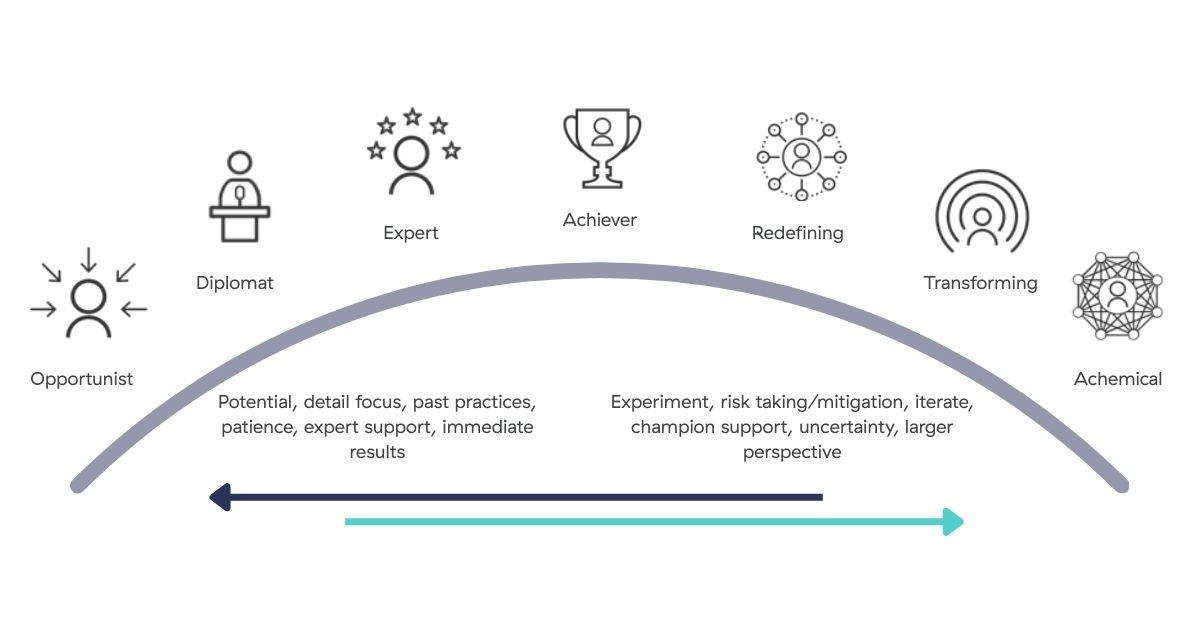
Adeption research has shown that 51.4% of people who initially access Diplomat, Expert, or Achiever mindsets (i.e. earlier mindsets) widen their range over the course of a development program. When people have a clear view of alternative ways to make sense of a situation, they tend to adapt quickly. The primary variable in growth rarely seems to be inherent capacity; rather, it comes down to awareness and having the explicit permission to experiment outside the usual zone of ease.
This insight offers a useful perspective for talent leaders looking to scale development across large populations. It indicates that the goal of a program does not have to be about taking leaders through intensive transformations to mature their mindsets. Instead, the work centers on creating a supportive environment that highlights the capabilities they already possess but may rarely use.
Reflective questions for talent strategies
When looking at your current leadership pipelines, consider:
- What specific mindsets do your upcoming business challenges demand?
- Are there invisible cultural norms or role expectations holding your leaders back from using their full mindset range?
- How can your programs offer explicit permission for people to experiment outside their comfort zones?
3. Mindset range is the ultimate growth path
Traditional vertical development strategies tend to focus on two distinct paths: mastering a current developmental stage or trying to graduate to the next one. The findings from working with thousands of leaders point to a third, equally impactful path – building mindset range.
Range is about growing the capacity to operate from a greater number of mindsets. It involves involves tuning into what a situation demands and moving fluidly between different ways of thinking, being and doing. It isn’t just about shifting gears arbitrarily, but rather learning to match the style to the challenge.
In a typical corporate ecosystem, there are times when an expert mode is precisely what is required to achieve immediate results. At the same time, leaders face situations that require a move toward experimentation and risk mitigation when things get ambiguous. Developing this flex allows people to adapt more smoothly to whatever comes at them.
4. Growth is a whole-person experience
Vertical leadership development has traditionally been treated as a purely cognitive exercise – a matter of teaching people to think differently. However, human beings don’t operate solely from a conceptual standpoint.
An individual’s mindset appears to be a mix of multiple channels working at the same time: emotional responses, relationship patterns, underlying assumptions, and how comfortable they feel with uncertainty. The shifts stick when development involves experiential learning – like heat experiments and real-world applications – that prompt the nervous system to try new ways of relating and doing.
At scale, this pattern points toward a style that puts the participant in the driver seat, with less emphasis on traditional one-on-one coaching. When leaders define their own learning edges and select activities that stretch them just outside their zone of ease, the behavioral shifts tend to be more sustainable because they are practiced in real-time, real-world contexts.
5. Awareness and intention do the heavy lifting
When reviewing reflections from leaders who have gone through the LMI experience, a consistent pattern stands out: roughly 8O% of personal growth stems from just two simple components:
- Awareness: Recognizing the default mindset you operate from, while noticing other perspectives that are available to you.
- Intention: Getting clear on why growth matters to you and what will shift as a result of that change.
Simply showing people a clear map of mindsets can change the dynamic immediately. When leaders understand where they are standing and have a compelling reason to explore new territory, meaningful behavior change follows naturally.
The reflections indicate that growth does not have to be an overly complicated or drawn-out process. The most sustainable shifts happen when frameworks remain clear and focus on practical experimentation, helping leaders connect their daily challenges directly to their broader goals.
Designing for organizational scale
For Head of People, Learning and Development, and Organizational Development professionals, these insights offer a modern lens on talent strategy. By treating mindset as a map, honoring existing capacity, and focusing on practical range rather than strict hierarchy, we can build development initiatives that feel accessible and relevant to leaders at every level of the business.
This approach does not replace the valuable foundations of vertical development theory – it simply adapts the framework to fit the reality, pace, and complexity of modern organizational life.
To explore the themes behind these insights and see how they can enhance your talent initiatives, you can download the complete position paper here. Or learn more about how the Leadership Mindset Indicator is designed to support scalable growth directly within your teams.